China’s Coast Guard conducted a new patrol east of Taiwan on 4 July, sending vessels to within roughly 54 nautical miles of Hualien County in the second publicly disclosed operation off Taiwan’s Pacific coast in a month, prompting a formal protest from Taipei.
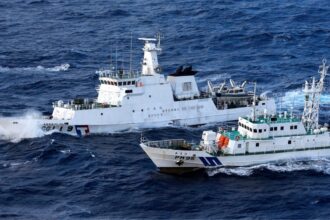
A China Coast Guard vessel monitored during
China Coast Guard spokesperson Jiang Lue said a task group led by the cutter Xiushan had replaced an earlier formation led by Daishan, which had conducted patrols, vessel inspections, fisheries protection and search-and-rescue operations in the area since June. Beijing described the latest deployment as a routine law-enforcement mission in waters it considers under Chinese jurisdiction.
Taiwan’s Coast Guard Administration rejected that claim, saying Taiwan exercises sovereign rights and jurisdiction within its exclusive economic zone and that “China has absolutely no sovereign rights over any waters surrounding Taiwan.” Taipei dispatched two coast guard vessels to shadow the Chinese ships throughout the patrol. Officials reported no confrontation.
The patrol’s location carries particular strategic significance. Hualien County is home to Chiashan Air Force Base, a fortified underground complex designed to shelter, arm and refuel approximately 200 fighter aircraft, including Taiwan’s F-16V fleet. Built into the mountains on Taiwan’s Pacific coast, the base was intended to make the island’s principal air combat reserve less vulnerable to a first wave of attacks originating from the Taiwan Strait.
Repeated Chinese coast guard operations in waters off Hualien reduce the geographic separation that has historically distinguished Taiwan’s eastern approaches from the more heavily contested waters west of the island. While the patrol remained outside Taiwan’s territorial sea, it brought Chinese law-enforcement vessels closer to one of Taiwan’s most important military installations than has traditionally been the case.
Security analysts say Beijing’s increasing reliance on white-hulled coast guard vessels, rather than People’s Liberation Army Navy warships, is a deliberate feature of its broader grey-zone campaign. Coast guard deployments enable China to expand its operational presence while reducing the likelihood of provoking the military responses that a comparable naval deployment might generate. Analysts assess that these missions contribute to Beijing’s broader objective of normalizing a sustained operational presence around Taiwan without crossing the threshold of armed conflict.
Saturday’s operation was the second publicly reported patrol east of Taiwan since a similar deployment in June prompted public statements from the United States, France, Germany and the United Kingdom. Beijing said the earlier operation was linked to Japan and the Philippines announcing formal maritime-boundary talks that China argued affected waters it claims around Taiwan.
The patrol forms part of China’s wider pattern of grey-zone operations combining coast guard deployments, maritime militia activity and People’s Liberation Army exercises. Western defence analysts assess that these activities are intended to gradually challenge Taiwan’s ability to exercise effective maritime control while complicating the range of responses available to Taipei and its partners. Although no confrontation occurred during the latest patrol, the operation marks another incremental reduction in the geographic separation that has historically insulated Taiwan’s Pacific coast from the more heavily contested waters of the Taiwan Strait.