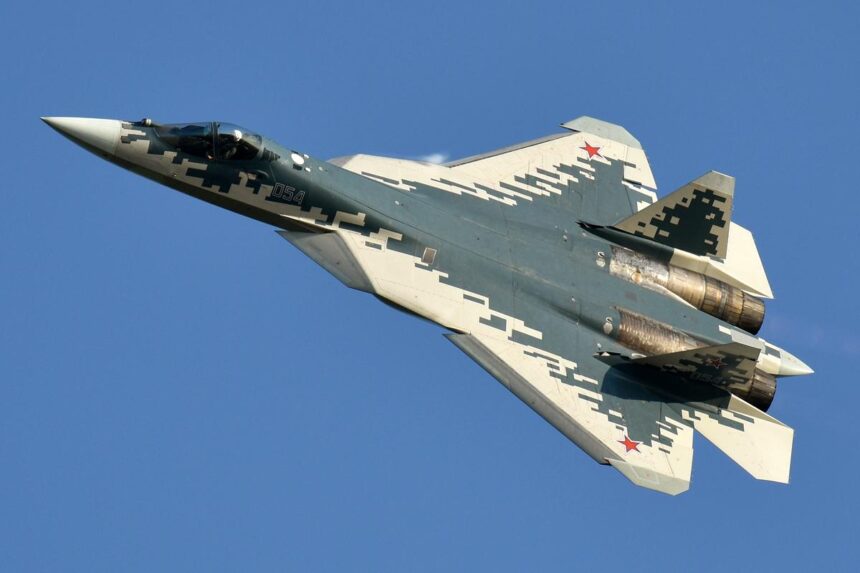
A Russian Su-57 fighter was photographed over Omsk during a Ukrainian drone strike on the city’s oil refinery, Russia’s largest, on July 6, according to the Ukrainian monitoring channel Exilenova+, a claim not yet independently corroborated by wire services or Russian officials. The same channel reported that Russia also scrambled an A-50U airborne early warning and control aircraft. If true, that raises a real question: why commit a large-area radar platform, designed to manage an entire air battle, to intercepting a handful of drones headed for one city? One plausible answer is a gap in ground-based radar coverage over Siberia, a region that has never needed dense air-defense infrastructure because no threat had ever reached it. That remains speculative, but it’s the kind of gap this sighting, if confirmed, would point to.
Whatever flew that day, it didn’t work. Ukrainian drones struck the ELOU-AVT-11 primary crude distillation unit at the Gazprom Neft-owned Omsk refinery, according to Militarnyi, after a flight that Ukrainian monitoring channels put at somewhere between 2,500 kilometers (straight-line distance from the border) and roughly 3,400 kilometers (estimated actual flight path). The unit’s raw processing share, roughly 40 percent of the plant’s 20-million-ton annual capacity, understates the actual damage. Primary distillation is the single point of failure in a refinery’s architecture: every downstream unit, catalytic cracking, reforming, everything that turns crude into usable fuel grades, depends on the feedstock this unit produces first. Knock it out, and the refinery doesn’t lose 40 percent of its output. It can lose most of what remains because the secondary units have nothing left to refine.
The Su-57’s presence, if accurate, points to a deeper problem than one contested sighting. Su-57s are among the scarcest and most expensive airframes in Russia’s inventory, exactly the kind of asset a military husbands for contested frontline airspace, not for chasing slow-moving strike drones over its own Siberian interior. Tasking one for this mission is not a show of strength. It’s a symptom of a gap: Russia does not have enough ground-based point defenses to protect economically vital interior infrastructure without pulling premium assets away from the front. That shortage is visible independently of the sighting dispute, in the Su-57’s own airframe. Multiple analysts, including The War Zone’s Thomas Newdick, have independently confirmed from photographs that Russian Su-57s have been fitted with external R-74 missiles and a 101KS-N targeting pod, hardware bolted onto hardpoints the jet was originally designed to avoid using, specifically to preserve the low radar signature that defines a fifth-generation aircraft. Trading that signature away to hunt drones is a sign that Russia is visibly running out of cheaper options.
What makes Omsk different from the dozens of refineries already hit closer to the front is distance, and distance was supposed to be the one form of protection Russia’s deep interior didn’t need to build. A strike of this depth collapses that assumption entirely. Until July 6, Omsk and the Angarsk plant in Irkutsk Oblast, protected less by defense than by geography. That protection is now gone as a matter of doctrine, not just as a single incident. Russia is left with two options, both costly: accept that its deep economic interior is now permanently exposed to unmitigated damage, or divert more of its already-stretched air-defense and interceptor capacity away from the front to cover a rear it had never previously needed to defend.